
Fall Rock Climbing in Western North Carolina: Conditions, Crags, and What to Expect
There's a morning every September when you step out of the truck in the Pisgah District and the air has changed. It's dry. There's a little breeze moving through the rhododendron. You put your hand on the rock and it's cool.
That's the start of the best climbing season in the Southeast.
We climb here year-round, and every season has terrain that suits it — that's one of the real advantages of being based in Brevard. But fall is when the widest range of it comes into condition at once, and it's the stretch of the calendar our guides look forward to most. If you're planning a trip to Pisgah, Looking Glass, or Linville Gorge this autumn, here's what changes, where to go, and how to time it.
Why fall is the strongest season here
The number that matters isn't temperature. It's humidity.
Dry air does two things at once: it improves the friction of rubber against stone, and it keeps your skin firm instead of soft. On friction-dependent rock — and most of what we climb around Pisgah is friction-dependent — that's a real, measurable difference. Holds feel more positive. Chalk stays dry. Shoes stick where they'd otherwise smear.
By mid-October, dew points across the region regularly sit in the 40s and 50s. Add a breeze and the rock dries fast and stays dry.
The second thing fall gives you is options. In summer you climb shade, you start early, and you go high — and there's excellent climbing to be had doing exactly that. In fall you can climb almost anything, on almost any aspect, at almost any hour. That flexibility is what makes October worth planning around.
Looking Glass Rock: when the eyebrows come alive

A Blueridge Parkway view of Looking Glass Rock in its beautiful fall colors.
Looking Glass Rock is the reason a lot of climbers come to Brevard, and it's the most conditions-sensitive stone in the region.
The dome is covered in eyebrows — horizontal features formed as the granite exfoliated in sheets. The simplest way to describe them: they're good holds that happen to be upside down. You don't pull up on an eyebrow, you pull down and out, hooking the underside. Once it clicks, it's some of the most enjoyable movement in American climbing. Before it clicks, it feels backwards.
Because that movement depends so heavily on feel and friction, Looking Glass rewards cool, dry days more than almost any crag I know.
I've climbed The Nose over two hundred times across twenty years, and the route has a personality that shifts through the year. Fall is when it's most itself.
Timing Looking Glass in fall:
The sweet spot is roughly 45–65°F. Warmer and shoes start sliding. Much colder and you lose the fingertip sensitivity that reading eyebrows requires — you can't feel the edge you're supposed to be hooking.
The South Face gets sun. That makes it the better call on cold, clear mornings and as the season pushes toward November.
The North Side stays shaded and cool — which makes it a great summer venue and a chilly late-fall one. Save it for the warm afternoons.
It dries faster than people expect. Looking Glass seeps, and the reputation for staying wet is somewhat overblown. With a breeze and low humidity, The Nose can come into condition within a few hours of rain. Check the forecast for wind and dew point, not just for precipitation.
Falcon closures are lifted. All of the peregrine closures in the region are off until January 15, so the full range of terrain is open through the fall season.
Linville Gorge: the window opens
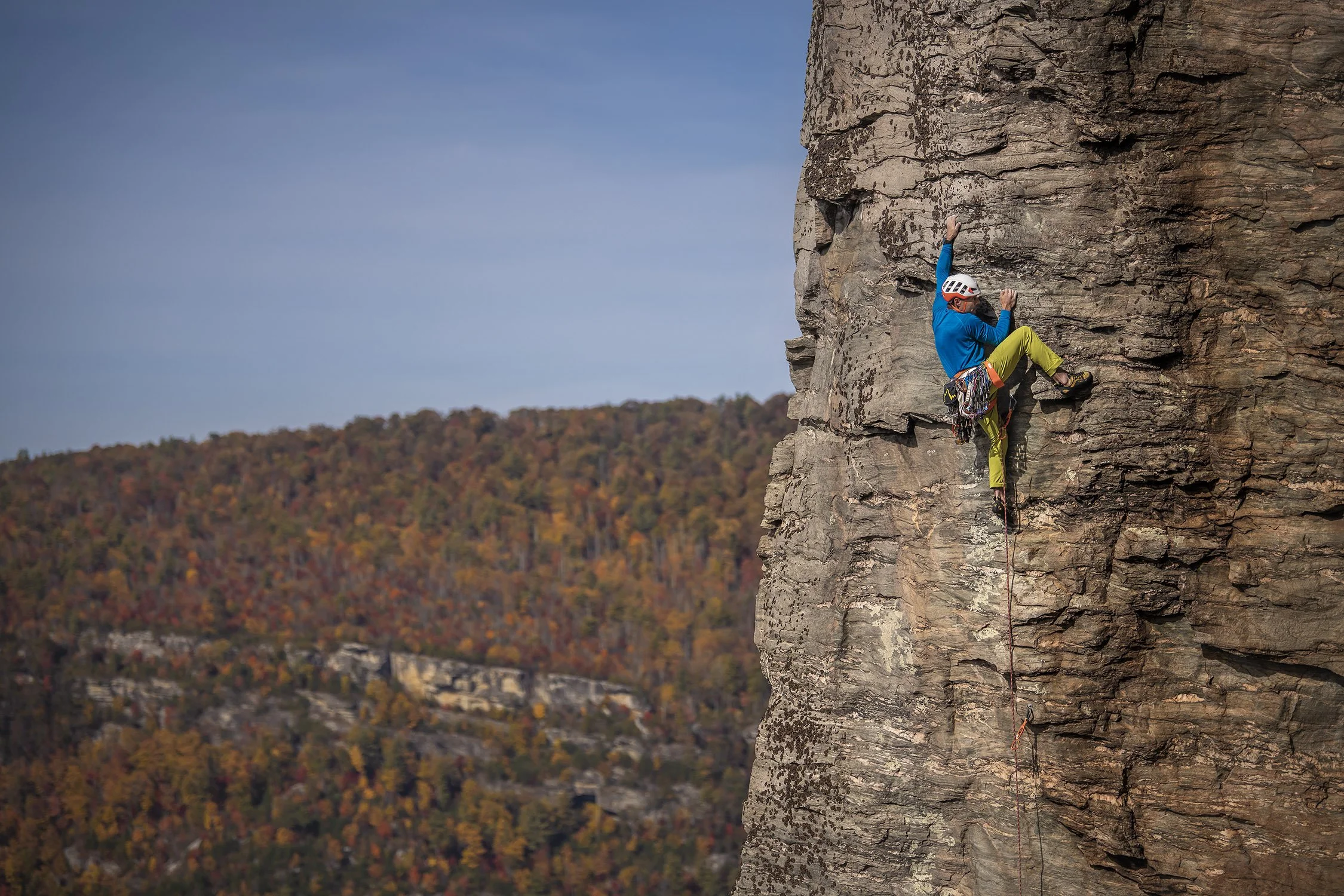
Linville Gorge is a different proposition. It's a designated Wilderness — roughly twelve thousand acres, the deepest gorge east of the Mississippi — with climbing running along Jonas Ridge from Table Rock and the Chimneys south to the big walls of Shortoff Mountain.
Fall is the Gorge's season. Cooler approaches, better light, and the kind of long, committing multi-pitch days that the place is known for. Experienced Southeastern climbers plan their year around October in Linville.
A few practical things for this fall in particular:
The road to Table Rock is still closed where it turns back to blacktop. That adds about a mile each way on foot. It's not a hardship in itself, but it changes your math — pair it with the long approaches and shrinking daylight and a plan that worked in September can put you on the descent in the dark by November. Budget the extra hour.
With the road closed, pick your approach to match your objective. The walk up the road is the better option for the Amphitheater and the North Carolina Wall. If you're heading for Table Rock itself — and especially for something like the North Ridge — go in from Spence Ridge instead. Choosing wrong costs you real time on a day when you don't have it to spare.
Shortoff catches sun and stays climbable well into cold weather. Table Rock and the Chimneys go into shade earlier in the day.
Falcon closures are lifted until January 15, so nothing on the ridge is off-limits this season.
Helene's effects are ongoing. Road and trail access in the Gorge has continued to change. Verify current conditions rather than relying on an old guidebook or a two-year-old trip report.
One honest note: the Gorge is remote. Descent gullies are unmarked and easy to miss, cell coverage is unreliable, and getting help to someone takes a long time. I do volunteer rescue work in this region and October is a busy month for it, usually for undramatic reasons — a party that started late, a missed descent, an approach that took longer than expected. Go with your route-finding and multi-pitch systems already sorted, and give yourself more daylight than you think you need.
Where else to go as the season turns
Fall doesn't end the season here — it starts a rotation. As temperatures drop you stop chasing shade and start chasing sun, and the good options shift around the map.
Early fall, while it's still warm:
Moores Wall in the Sauratown Mountains — quartzite, big features, and a completely different style from Pisgah granite. It's shady and gets genuinely cold, so catch it in September and early October rather than saving it for November.
Ship Rock on the Blue Ridge Parkway. Shady, high, and beautiful — the elevation means the leaves turn there well before they do down in Brevard, and on a clear day the setting is hard to beat. Parkway access has been intermittent recently, so confirm the road is open before you make the drive.
The North Side of Looking Glass, for the same reason it works in summer.
Late fall, chasing sun:
Shortoff Mountain and the South Face of Looking Glass — both hold warmth well into cold weather.
Pilot Mountain — lower elevation, sunny aspects, and a reliable day when the mountains are socked in.
Winter, when the NC mountains shut down:
Cherokee Rock Village in Alabama — sandstone, and a proper winter destination.
Big Rock in South Carolina — another good answer when it's simply too cold up here.
Learning this rotation is a big part of climbing in the Southeast. There's almost always somewhere good. The skill is knowing where.
What to expect if this is your first outdoor day
Dress for standing still, not for climbing. You'll be warm while moving and cold while belaying or waiting at an anchor. Layers you can add and shed matter more than one warm jacket. A light puffy and a wind shell cover most fall days.
Put a hand warmer in your chalk bag. This is the single best cold-weather trick we teach, and almost nobody thinks of it on their own. Your hands warm up every time you chalk, which is exactly when you need them to. It costs a dollar and transforms a chilly day.
Cold fingers on the first climb are normal. Hands take time to come around on a cool morning. The first route of the day often feels worse than the third — don't read that as a verdict on your ability.
Start earlier than feels necessary. Sunset moves from around 8:15 in mid-August to roughly 5:20 by early November. That's nearly three hours of daylight gone. A multi-pitch day that was relaxed in September becomes a headlamp descent in November if you leave the parking lot at the same time.
Build in traffic time in October. Leaf season brings enormous numbers of visitors to Pisgah and the Parkway. Trailhead parking fills early and roads that take twenty minutes in April can take an hour on an October Saturday. We plan around it — you should too.
How we build fall days
For people who've never climbed outside, a Rock 101 day at an accessible crag is the right entry point — real rock, top-rope, and enough coaching that the movement starts to click rather than just feeling like a workout.
For climbers with gym experience who want to lead outside or move onto multi-pitch terrain, fall is an ideal season to work on systems, because you're not managing heat while you're trying to learn something new.
And for people who want the full Pisgah experience, a guided ascent of The Nose in October is about as good as Southeastern climbing gets. Cool air, good friction, and a view off the top that justifies the whole day.
You can see the full range on our climbing programs page, or get in touch and tell us what you're after — we'll tell you honestly whether it's the right fit for where you are.
Frequently asked questions
When is the best time to go rock climbing near Asheville? Mid-September through early November is the strongest window. Humidity drops, friction improves, and daytime temperatures sit in a range that's comfortable for both climbing and belaying. Late October is typically the peak, though it also coincides with the busiest leaf-season traffic. That said, there's good climbing here in every season — summer just means shade, higher elevation, and earlier starts.
Is fall a good time for a first outdoor climbing day? It's excellent. Cool, dry conditions make holds feel more positive and shoes perform better, so beginners get an accurate sense of the movement instead of fighting slick rock. The main adjustments are layering properly and starting earlier for shorter daylight.
Is Looking Glass Rock hard to climb? Looking Glass has routes across a wide difficulty range, but its eyebrow features ask for a specific technique — pulling down and out on holds that are essentially upside down, rather than up on positive edges. Most climbers find the style unfamiliar at first regardless of their grade. Guided instruction shortens that learning curve considerably.
Do I need my own gear for a guided climbing day? No. We provide all technical equipment — harness, helmet, ropes, and protection. Most climbers bring their own shoes if they have them, and we have rentals if not. You'll want layers, water, and food for the day.
Can I climb in Linville Gorge without a guide? Of course. The Gorge is public Wilderness and it's there for everyone — plenty of climbers have great days in there entirely on their own. What it asks of you is honesty about your experience: long approaches, committing multi-pitch trad, sparse fixed protection, and descents that are genuinely easy to miss. If your route-finding and self-rescue skills are solid, go have a fantastic day. If you're not sure yet, a guided day is a good way to learn the terrain before you come back on your own.
How late in the year can you climb in Western North Carolina? Year-round, if you move around. As the high country cools, climbers shift to sunny aspects and lower elevations — Shortoff Mountain, the South Face of Looking Glass, Pilot Mountain — and eventually south to Cherokee Rock Village in Alabama or Big Rock in South Carolina when it's simply too cold up here.
Pisgah Climbing School is based in Brevard, North Carolina, in the heart of Pisgah National Forest. Fall dates book up quickly — get in touch to plan your day.