
Essential Climbing Gear: How to Build Your Kit from Beginner to Advanced
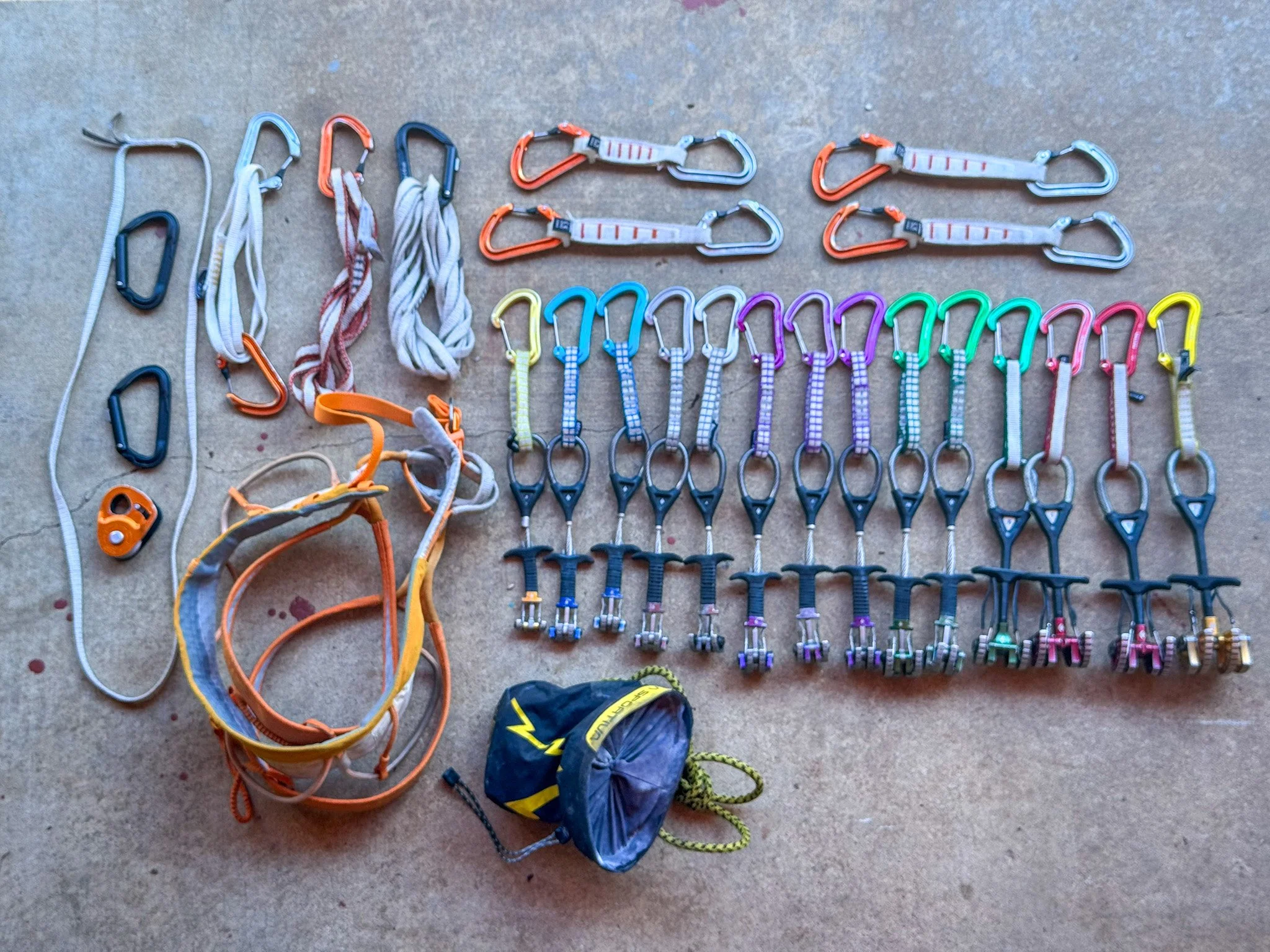
This is a very minimal climbing rack that Karsten and Zack Mintz used to get the partner FKT on the Linville Crusher.
By Pisgah Climbing School | Brevard, North Carolina
Getting into rock climbing is one of the most rewarding decisions you can make — but before you head to the crag, you need the right gear. The good news: you don't have to buy everything at once. Climbing gear builds naturally in stages as your skills progress.
This guide breaks down the essential climbing gear for every level, from your very first harness to a full trad rack, with honest pros and cons on our favorite picks.
Beginner Climbing Gear: The Core Four
Every climber starts here. These four pieces of gear are what you need to get on the rock safely from day one.
1. Climbing Harness
Your harness is what keeps you attached to the rope — it's non-negotiable. A good beginner harness should be adjustable (so it fits over varying layers of clothing), comfortable enough to hang in, and suited to your discipline.
Our favorites:
Petzl Corax The Corax is our top pick for beginners. It's affordable, highly adjustable, and padded generously enough to stay comfortable on long days. The trade-off is a bit of bulk, but for someone still learning the ropes, that padding is worth it.
Petzl Hirundos A step up in performance — lightweight, streamlined, and comfortable for gym and sport climbing. Gear loops are smaller than a trad harness, but for single-pitch climbing it's an excellent choice.
Petzl Sitta The Sitta is built for trad climbing and mountaineering. Large gear loops with dividers keep your rack organized, and the weight savings matter on longer objectives. It costs more, but it grows with you as your climbing does.
2. Climbing Helmet
A helmet protects your head from falling rock, dropped gear, and the wall itself if you take a swinging fall. It is not optional. Choose one that fits snugly, sits level on your head, and carries UIAA or CE certification.
Need help decoding helmet safety ratings? Petzl's helmet guide is a great resource.
Our favorites:
Petzl Meteor — Lightweight and well-ventilated; great all-around helmet for sport and trad
Petzl Sirocco — The lightest option in the lineup; ideal for long days and warm weather
Petzl Boreo — Most affordable of the three; durable and reliable for beginners
3. Climbing Shoes
Climbing shoes are the direct interface between you and the rock. A well-fitting shoe lets you stand precisely on small edges, smear on slabs, and feel the rock beneath your feet. For beginners, prioritize comfort and a neutral (flat) or mildly downturned profile. Aggressive shoes come later.
Our favorites:
La Sportiva Finale Affordable, flexible, and well-rounded — an excellent first shoe, especially for slab climbing. Not designed for steep, overhanging terrain, but that's not where beginners should be starting anyway.
La Sportiva Katana A step up in performance with a pointed toe for small edges and a moderate downturn that adds power without sacrificing all-day comfort. The lace closure makes swapping between climbs slower, but the fit and feel are exceptional. Worth the investment once you're climbing regularly.
4. Belay Device
Every belay device falls into one of two categories: Manual Braking Devices (MBD) and Assisted Braking Devices (ABD). MBDs require attentive technique; ABDs provide mechanical assistance in catching a fall. Both require proper training — no device replaces good belaying habits.
Our favorites:
Petzl Grigri (ABD) The Grigri is the most versatile and widely used assisted braking device on the market. It's streamlined, functional across a wide range of situations, and can even be used for simple rescue scenarios. Limitation: it only handles a single strand of rope.
Petzl Reverso (MBD — Tube Style) The Reverso is the workhorse tube device. Affordable, capable of handling two strands of rope, and excellent for rappelling. It requires more active technique than a Grigri, which is actually a good thing for developing fundamental belay skills.
Many climbers carry both — the Grigri for active belaying, the Reverso for rappels and anchor management.
Intermediate Climbing Gear: Rope and Anchor Building
Once you're leading routes or setting up your own top rope anchors, you'll need a rope and the material to build safe anchor systems.
5. Climbing Rope
Dynamic ropes stretch under load to absorb the energy of a fall — this is what you want for lead climbing and top roping. Static ropes don't stretch and are used for hauling, fixed lines, or top rope soloing.
For most climbers, a 9.8–10.2 mm single rope in 60 or 70 meters is the right starting point. Longer ropes give you more flexibility at crags with taller routes; thicker ropes hold up better to the wear of repeated top rope use.
Our favorite: Bluewater Xenon Bluewater is a local, Southeastern company that has been manufacturing climbing ropes since 1969 — right here in our backyard. The Xenon is lightweight, durable, and tightly braided for long-term performance. Supporting a regional brand that's been in the game for over 50 years is a bonus.
6. Anchor Building Material
Setting up a top rope anchor or building a belay station on a multi-pitch requires slings, carabiners, and cordalette. These skills require hands-on instruction before you use them independently — anchor failure is catastrophic. Take a course, practice with a guide, and build your knowledge alongside your gear collection.
Cordalette A length of 7mm cord (~21 feet) is the foundation of many anchor systems. Bluewater makes our preferred option here as well.
Slings (Petzl Dyneema)
180 cm slings — ideal for building quads and trad anchors
120 cm slings — the standard length for most bolted anchor setups
Carabiners Carabiners connect every component of an anchor system. Two types cover the majority of climbing situations:
Non-locking carabiners — for racking gear on your harness and quick-clipping. Our favorite: Petzl Spirit
Locking carabiners — for belay devices, anchor master points, and any connection where security is critical. Our favorite: Petzl Attache — a pear-shaped HMS locker that's versatile enough to handle almost any application
Advanced Climbing Gear: Sport and Trad
When you're ready to lead climb — to be the first person up, clipping protection as you go — your gear needs expand significantly. What you buy depends on whether you're heading toward sport climbing or trad climbing.
Sport Climbing: Quickdraws
Sport climbing routes use pre-placed bolts in the rock. Your job as the leader is to clip those bolts with quickdraws as you climb. A standard rack for a sport route is 10–12 quickdraws.
Our favorite: Petzl Spirit Express Lightweight, durable, and smooth-clipping. The Spirit Express is a workhorse draw that performs well from your first redpoint to your hundredth.
Trad Climbing: The Full Rack
Traditional climbing — "trad" — means placing your own protection in cracks and features as you climb, then removing it when you descend. It's the most gear-intensive discipline in rock climbing and requires the most thorough instruction before you attempt it independently.
A beginning trad rack includes:
Cams (Spring-Loaded Camming Devices) The primary protection piece for crack climbing. They come in a wide range of sizes to match crack widths — a full rack typically covers from fingertip-size to fist-size and beyond.
Nuts (Stoppers) Passive protection placed in constrictions in the rock. Lighter and simpler than cams; every trad rack starts with a set.
Slings and Alpine Draws Used for extending placements, building natural anchors around trees or horns, and reducing rope drag on wandering routes.
Nut Tool A simple but essential tool for removing stuck protection. You will need one.
For a detailed breakdown of what to buy for your first trad rack, read this guide by PCS Head Guide Karsten Delap: Beginning Trad Rack: What to Buy
Gear Is Only Half the Equation
The right gear matters — but it only keeps you safe when you know how to use it. Climbing involves real risk, and the knowledge and skills you build are your most important protection.
At Pisgah Climbing School, our AMGA-certified guides teach everything from first-time top roping to trad lead climbing and anchor building, on real rock in Pisgah National Forest. We can help you build your skills in the same progression as your gear — safely, confidently, and with expert instruction every step of the way.